
Where Memory Lives
exploring the soft thumbprints in our lives

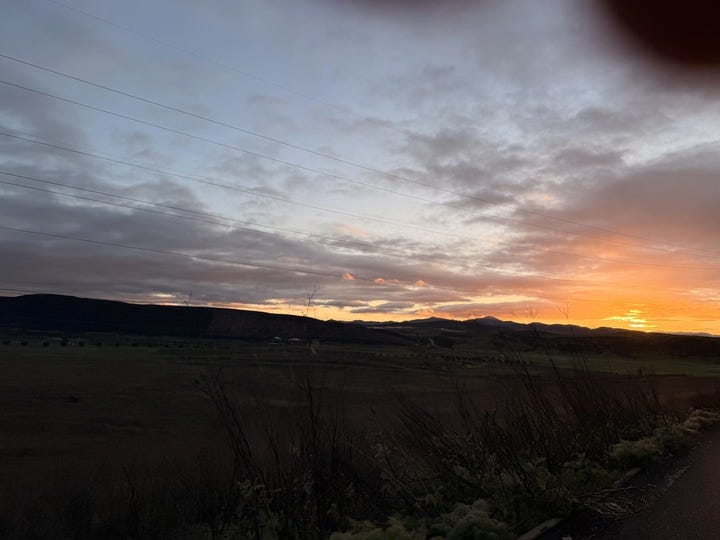
The car gently bobbed up and down the paved terrain of Valle de Guadalupe before sunrise on the morning of January 2nd. For the first time in 48 hours, the rain ceased.
I watched the sun crest over eastern mountains, first as glints of red light, then spilling into the valley below, chasing away low-hung bands of mist that clung to the neck of the hills like a scarf. The morning light woke the sleepy farm dogs with a gentle nudge and they began to lift their heads as we passed. Over my right shoulder birds flocked above dew laden grass in a synchronized dance.
I rolled down my window and inhaled, enveloping myself with petrichor, the distinctive smell of dry soil after rain. Earthy and damp, fertile soil is one of the most calming human scents because of its promise of abundance. The collective memory of life longing for itself came alive in me and I was no longer experiencing Valle de Guadalupe, I was remembering it.
I like to call these moments the zaps, when you tap into the collective consciousness and experience an eerie feeling of familiarity. My breath typically shortens and time slows down ever so slightly as the felt sense is experienced, then time speeds back up at 1.2x speed to catch up with the whirl of the world. When the zaps happen I’m always left a little woozy but elated, like a time traveler bending space.
It happened driving through the Catskill Mountains the night before my wedding when I turned to see my goddaughter in the back seat with my veil on her head.
It happened early one summer morning while swimming in the Atlantic when a sun shower erupted—cool rain drops casting a million mini-rainbows.
It happened when my toddler sister crawled on top of my teenage self and fell asleep with her fat pink cheek pressed upon my chest.
It happened in my 20s when drug-like-induced-lust found us on the kitchen floor because it was the nearest surface, moonlight bright as day.
It happened in a graveyard in Scotland, when I pushed back encroaching grass on a small heart shaped stone to discover it marked the grave of a four-year-old from the 16th century.
The zaps tap into a trillion human memories, but they all boil down to love, grief, joy and survival. I like to call them the zaps because science explains déjà vu’s origin from the mind, but I believe memory lives beyond the mind—in our bodies, the land, and the cells we pass to another.
—
I miscarried last fall and during the drawn out process learned that the embryo’s DNA can be traceable in my blood for the rest of my days, like a soft thumbprint on the map of my life.
It’s a phenomenon called fetal-maternal microchimerism, which involves fetal cells crossing the placenta and finding a home in the mother’s body for years or even decades to come. The fetal cells have been found integrating into various organs like the heart, brain, and liver, possibly aiding in tissue repair—which challenges the idea of a clean biological separation between mother and child.
It also makes room for theories of multi-generational trauma, or memories from the past being held in one’s present body—we imprint on them, as they are on us, like the original “coding” of the universe. Which is how we recognize the smell of petrichor and why geese fly south without much question.
—
Valle de Guadalupe in Baja, Mexico is classified as a mediterranean climate, only 15 miles from the Pacific and with a terroir that produces rich and varied soil. My matriarchal and patriarchal line descend from two small islands off the coast of Croatia and Greece respectively. Fertile land deeply influenced by the surrounding sea.
While it was my first time in Valle de Guadalupe, I felt the knowing of ancestral land, brimming with seafood, olive oil, herbs, and sleepy farm dogs. Passed down by generations of soft maternal thumbprints. It allowed my soul to settle into a state of being acutely alive but deeply at rest.
I wish to be more philosophically brave, and less scientifically rigid in matters of the unknown. We are less separate than we think. From each other, from those we lose, from the land we stand on, and from time itself. Because there is a continuity of self beyond a single moment, a continuity of memory beyond time, and a continuity of bodies beyond separation.
This is beautiful, Veronica!! I want to read it again and again!
Your words aren’t words girl!!! They’re bread! Keep on feeding us dammit🙏🏼